How Men of Quality Resolve Differences

How Men of Quality Resolve Differences
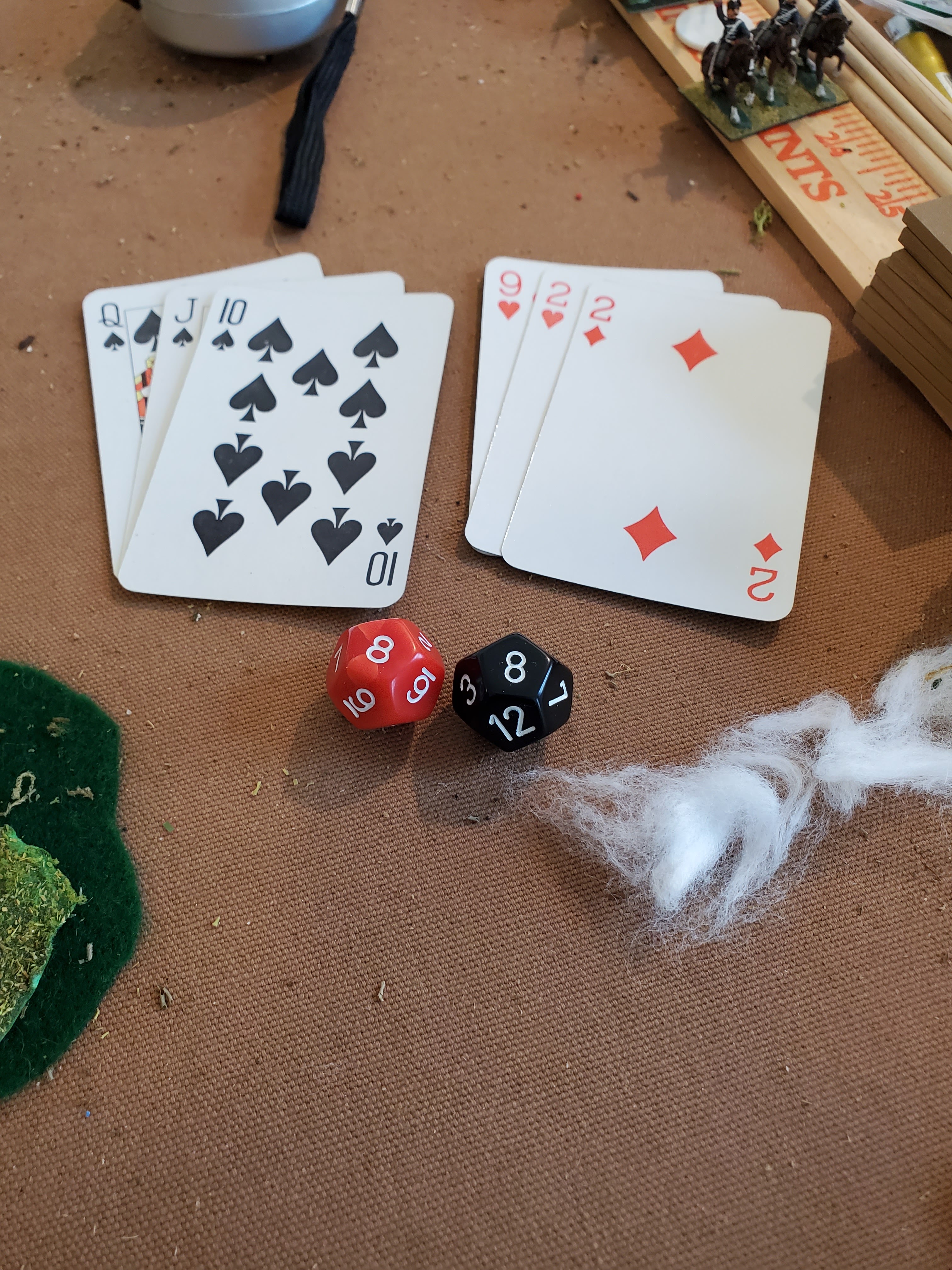
Pudel and Peper attacks - an ugly but inevitable part of any 17th C. British Civil War, "Oh! The Shame of it All!"
Showing posts with label A Gentleman's War. Show all posts

Sunday, April 30, 2023

A Gentleman's War: Gone to Tsingtau!

"Very Pretty, Herr Waldeck...But Can they Fight??"


Last month, got together with my favorite most available retired gamer dude, Reg, and put his 25mm WWI Far East Germans and Japanese on the table. This conflict largely revolved around the Japanese helping the Allied war effort by reducing the German far east possession of Tsingtao [not without some self-interest being involved, of course].  Don't believe that the Germans and Japanese fought each other?  The story is here: CLICK!

Rules used were "A Gentleman's War" previously demonstrated with Reg's Blue v. Red armies, in the true Old School gaming tradition [CLICK] for which the rules are designed.

German commander, suitably dashing and properly attired - 
just needs a cigarette hold [a loooong cigarette holder] and perhaps a Luger?
 
First German troop unit - 12 riflemen w' NCO and officer

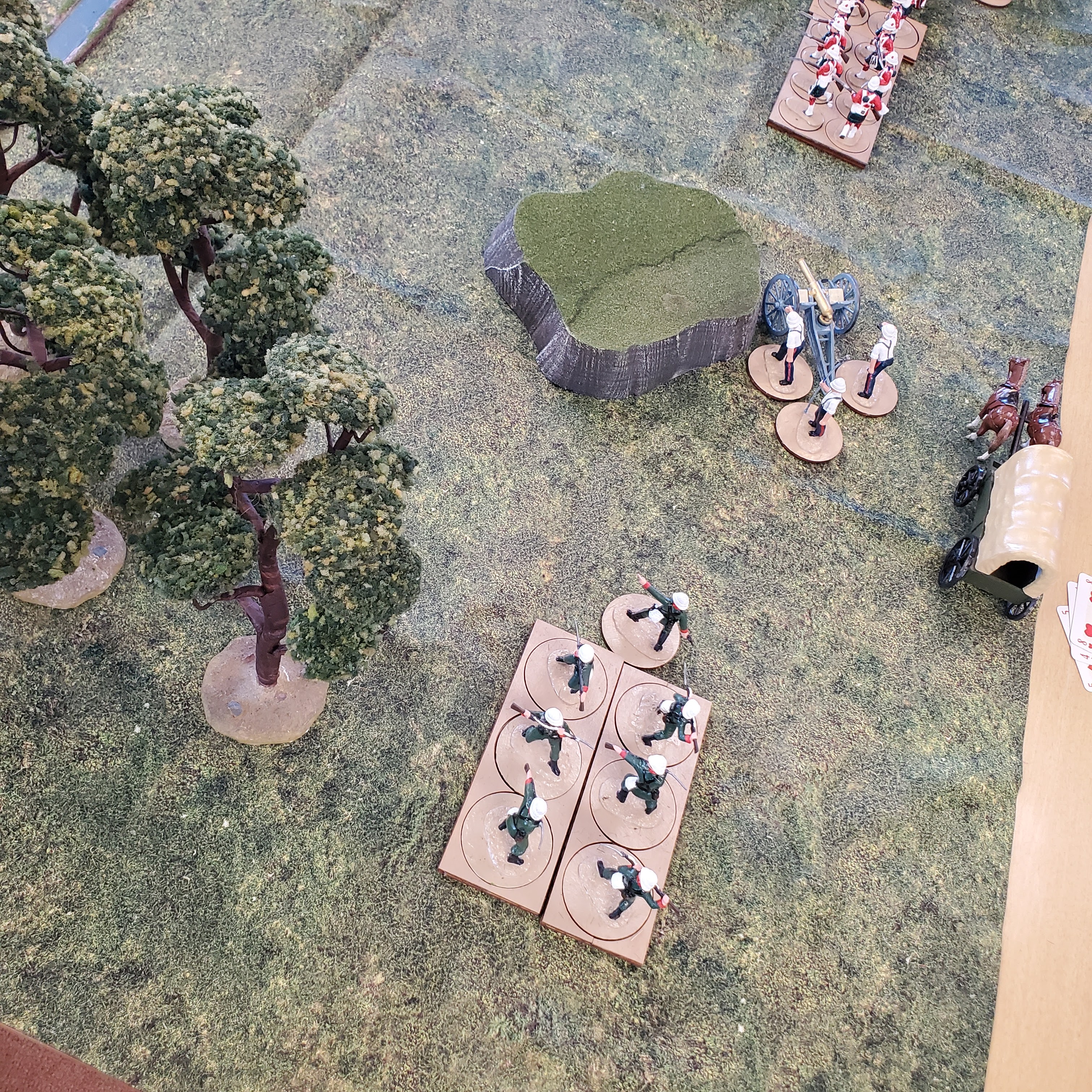
Ten sailors with officer and NCO

12 more rifles with officer and NCO

Mounted infantry - 6 Mounted / Dismounted, 6 on foot.

Two maxims, and some sort of pom-pom gun on loan from the navy.

German officers hold a brief staff huddle as they regard the advancing Japanese column. Col Fritz Lieber boldly announced "We will hold the village and interdict the road - failure is not an option or Tsingtao falls!"


Meanwhile, advancing down the road is Col. Kurasawa, who has vowed not to sheath his sword until it has drawn blood, and his ray-bans have seen the heels of the round-eyed imperialists!
"You are surprise I speak you language - but I was educated at your UCRA!"

Honorable mounted Samurai?

The cavalry is on the center right, with rifle squad closely supporting.  Beyond is a gun, a rifle squad with Maxim, another squad, and a large reserve of two rifle squads and another maxim.

Lovely figs and characterful paint jobs make for a pleasurable table display!
Mat is Russian, the trees are Chinese doller-store stuff so it should all fit together well visually!

The Japanese reserve will enter next turn, supporting the main effort. Two squads of rifles are durable and have some punch shooting or in close combat.

The Hold Cards are drawn, and significantly favor the attacking Japanese - clearly, they did their scouting well and have informers in the village!
But, at least the doughty Germans have one Face Card up their sleeve...

Japanese make a strong forward attack against the village.  It is held my Naval squads with support. They hold strong so the Japanese close the range to turn up the heat, with a gun and a maxim firing at point blank range - that will ventilate those stifling huts nicely!

Honorable Regitori wisely dismounts his cavalry after being ambushed by a wily German Maxim from the woods.

Overwhelming force is brought to bear against the scattered Germans. Being separated in the houses proved a big disadvantage, as the Germans had to wait for cards to fire, but the united Japanese advance was firing altogether, and cycling faster.  
The Germans react by moving up the cavalry,  and a maxim on their right flank.

Under heavy pressure, German squad and maxim "advance to the rear" to regroup!

Japanese firepower clears the near houses entirely. Dead sailors litter the streets!
The German pom-pom advances in support, only to be met by a hail of lead and lose two crew.

With several units on their last couple of figs, and fleeing, the Germans will not be able to resist the Japanese drive down the road. The flanks were a bit too strong and the center a bit too weak.  

This battle reminded me that it is VERY important to organize a brigade firing line around The General - this way he can organize concentrated firepower of 4 units, which shortens the cycle and allows them to fire more often.  As the Germans took losses, they eventually fled and the scattered units also bog down the card cycle, slowing German reactions.

Another fun and characterful fight!  

As previously stated, the card sequence is the most ingenious part of the game.  It is easy to use, rewards skillful play, and yet gives a very realistic feel without a lot of complicated rules that in other sets fill several pages.

Only thing we thought should be changed is that the weapons should be selected to be a bit more lethal, which would speed the game up without changing any of the important aspects of tactical play.  Perhaps adding some more range as well...

Still, there was a price to pay, and all this violence was for a product easily obtainable today...


I will look forward to getting AGW out for my Mexican Civil War units.  I wonder how they would do with Spanish Civil War?  Hmmmm.....

Thursday, March 9, 2023

A Gentleman's War: Gone to Fight the Blues

Gen. Reginald von Frankenfurter supervises laying of his Krupp gun. 
The laying of the gunners must be settled after the battle...

It's been a while since I dusted off and played that military masterpiece by Howard Whitehouse "A Gentleman's War" [ably assisted by Mr. Daniel Foley, Zoltan Korda, C. Aubrey Smith and June Duprez, oh wait...], so it was with zero hesitation that I invited Reg and his force of nicely shiny Blues and Reds [courtesy of Armies in Plastic] out to a game lunch and Pulp Action Library's biggest hit since TV went colorized:


Below, the Venerable General of a thousand tabletop battles and decorations and awards too numerous to count, Gen Reg von Frankenfurter, collects his thoughts before unleashing h**l against his opponent, Gen. Alexander Crumpets, and his Reds.  Units are 7-10 figs in size, 7 each side, composed of four Infantry, one light, one light gun and one cavalry each.
As this was a first game for Blue, we decided on the simplest scenario "Open Battle" which ends when either side has driven half the opposition from the field, preferably before dinner.

Let's see what happened!

To Crumpet's right, Blues began with no unit in the house [hmmm....] a light cavalry and two Infantry towards the center.
The small rise counts as a hill.  The stream counts as rough going as the Soldiers need to polish their shoes after crossing it.

The center is held by that marvelous machine of mayhem, a Krupp light gun with two Infantry to left of it, being led by a Jager [Light] unit that plans to sieze the woods.  The wagon holds comestibles, combustibles, and "medicinal schnapps", so must be protected!

General von Frankenfurter strikes a pose next to his loyal standard bearer, 
Feldwebelanwärter Augustus von Frankfurter, his nephew. 
"Feuer! Feuer! Entfesseln Sie die Holle!" he cries, brandishing his Walther PPK.  
Hmmm... this all seems somewhat familiar...need more woods perhaps?

On the right, Gen Alexander Crumpet successfully masses his strength: four Infantry units and one Light Cavalry. He himself stands behind this key strike force, with his trusty piper, Staff Sergeant Archibald MacGillivray, pipe champion of Clan Chattham [CLICK] and slayer of a thousand eardrums. Holding his trusty revolver by his side, he shouts "Touch not this Cat but with a glove ye Teutonic Rabble!"

Towards the center, that marvelous machine of mayhem known in Blighty as the Whitworth light field gun shelters in defilade, prepared to support the Main Effort to its right.  Behind, the invaluable wagon holds comestibles, combustibles, and "medicinal brandy", not to mention Stumpets and Crumpets, so must be protected!

The field in its entirety.  Most likely Belgium, famous for its central position on the Continent, not to mention 457 kinds of beer and mussels - something to fight for!

View from the other side - Leftenant Abernathy is taking images from hislighter-than-air balloon it seems...Hold cards are three numbers apiece, nothing exciting.

First card cycles. The Prussians probe Red right, which is countered by a rapid advance of the East Stampeding Fusiliers [you can see they are running] towards the house.

Fire is exchanged, with Blue coming off the worst.

With crossfire from the Whitworth and a weak force ahead, Red continues to reinforce the advance with the other company of Fusiliers and the Royal Highland Islays.  "Peat and More Peat!" they shout their battle-cry of victory.
Meanwhile, the Dull Rifles company keeps the jagers busy in the woods.

After a second cycle shortened by the second Joker, a new draw of Hold Cards is made - it seems Mars is favoring Blue somewhat, fickle god he is.

A frontal cavalry charge against the Fusiliers left company atop the rise is seen off with half casualties as they Run Away to fight another day. The probing company of Blue Infantry did a Fall Back and are near 50%.  Red senses victory!

Well into his 3rd card cycle, Gen Crumpet is poised to seize the building as a base of fire to continue the Big Push into the Blue left. Granted, one company of the Fusiliers is at 50%, but they are Brave Lads and Carry On.
As the sun begins westering [a late brunch was had by all] Gen Crumpet unleashes the "Lucky 13th" Kings Own Nobby-knackered Horse upon the rear of the fleeing Lancers!

Unfortunately, they were able to turn around and order themselves quickly. Altho they took the charge at the halt, outnumbered, their pig-stickers apparently made up for it and they were able to drive off the Lucky 13th, Disordered and with quite some losses. This set back was somewhat compensated for by the Fusiliers seizure of the house, which has the Blue left somewhat Flummuxed...or was that Confounded?

Unfortunately, Major Haberdasher on the left has found himself being steadily forced back by the slow but resolute advance of the Prussian right. His Dullard Rifles fled the woods and then the field, allowing the Jagers to seize the wood.
Meanwhile, the Prussian left holds grimly to the ground upon which they stand, despite numerous morale checks caused by significant losses: the cavalry and an infantry at 50%, the other infantry at 33%.

The Islays hold the center, but the Blues have ammassed a Brigade of shooting and a short card cycle, while the one Fusilier company and the Lucky 13th are reduced to a single figure apiece, as is the Whitworth.

With four of his units destroyed, fled or reduced to a figure and not long for the fight, Gen Crumpet graciously concedes victory and invites Gen Frankenfurter to Tea and Strumpets as any Good Gentleman should!

Between lack of urgency, checking the rules and plenty of conversation, the time was coming to a close and the British were getting the worst of it by the end.

Despite a Plan clever enough to be thought of by a Fox that read Clever at Cambridge, poor morale rolls halted the British advance on the right. This was compounded by the British failure to organize a Brigade firing line quickly enough to handle the firepower of the Blue Infantry and Krupp gun.

Most interesting about the game was the card-driven sequence, which admirably kept the game interesting but rewarded thoughtful play.  It is undoubtedly the most unusual and well-developed aspect of these rules, turning it from "just another colorful and fun set of old-school rules" into A Thinking Gentleman's War that is rewarding to get acquainted with and pull out regularly.

As previously commented upon in my Franco-Prussian playtest, the card sequence admirably handles the friction of battle by turning cards from a single deck, sequentially, allowing one Unit to activate on a number and up to four units to "brigade" and activate on a face card - but they all must do the same thing. Generals can have a bit impact by making it easier to Brigade, but you can't activate a force again until your card sequence ends with every unit having activated.  

Thus, it is smart to Brigade as often as possible, perhaps on two "Wings" of a small force, one moving, the other firing. However, when units fail morale, they Run Away and break up the Brigade.  All of this takes care of generalship and tactics quite admirably [with a bunch of other little twists I shan't reveal" making the card sequence worth the price of the rules alone, IMHO.  It would work with most rules and fighting mechanics.

We both enjoyed ourselves, and plan to play "A Gentleman's War" again soon, perhaps with another set of Reg's figures, 28mm Germans and Japanese from 1915, which sound exotic and interesting to me!

The 54's were very much in the spirit of the game and fun to look at. 40s and 28s would also be enjoyable and leave more space on the 6x4 table for bigger units. As the units were identical on both sides, this didn't matter but Medium Armies of 10--13 Units would definitely need an 8' table I'd say.

Until next time, watch your flanks and keep your sherry dry!

Sunday, September 18, 2022

A Gentleman's War: Gone to France


After quite a bit of time reading the download pdf of the rules and playing around with 54mm ACW figures, I wanted to see how AGW plays with 15mm. While a "more modern" scale than intended by the rules, and a rare one for single-figure basing, I wanted to see how 15mm played and without individual basing. The unit size is about right - 16 figs for Infantry, 6 for cavalry. Gives the infantry battalions a bit more edge as they should have in this late period.

Also, I bought a nice shiny softcover of the rules. Basically, because I like real things. Howard will no doubt not only approve, but recommend I buy a few extra copies to keep around the house "just in case".
:)

Astute observers will recognize "Scenario 8: Melee" from One-Hour Wargames. All I did was add a few more bits of terrain to get the feel of a higher scale battle. The road, the long hill and the medium sized woods at the southeast corner are the original terrain features.

The defending French have:
- a General, a smoothbore cannon, line infantry and light infantry starting on the hill
- a mitrailleuse [gatling sort of thing] and two infantry entering as reinforcements at the road.
- a General, 4 Light Cavalry sqadrons [entering as reinforcements at the top left]
TOTAL = 4 Infantry, 4 Cavalry, 2 Guns, 2 Generals

Turn 3 reinforcements:

Turn 6 Reinforcements:

The Attacking Prussians have:
- a General, two Infantry, a Krupp gun and two squadrons of lt. Dragoons to start.
- a General, two Infantry, a Krupp gun and two squadrons of Cuirassiers entering Turn 4.

Prussian Turn 4 Reinforcements:
All figures are available from Old glory 15s, I believe [CLICK], and are either Old Glory or Rank and File. The OG are more animated and have varied poses, usually 2 advancing and 2 shooting per pack, along with the command figs. The Rank & File are generally one pose, very clean casts, and something old school. I like them both for different reasons!

Initial card distro favors the French a bit, 4-2 Hold Cards, but both sides have 2 face cards.

Turns [card cycles] 1-2. Uncertain what the Prussians have planned, the French move into the woods with one skirmish unit - the rest of the force stands fast. 

In "One-Hour Wargames" Scenario #8, there's two plans with a chance of success in my experience...
First, go directly against the front of the hill, with 4-3 odds, hoping to destroy a unit or two. Turn 4, push the reinforcements up the road to stop the Red defender's reinforcements entering the same road. Somewhere between these two forces, secure the woods and clear the hill with fire.  \
Second, push up the road, securing the woods, and then flank the forces on the hill. This only works if you are fast as on Turn 3 Red gets reinforcements arriving on the road. It also largely changes the direction of battle from South-North to East-West. The final reinforcements for the defender enter from the Northwest.
Of course, anything can go wrong and overall I think this scenario is likely a draw as the winner must be in "exclusive" possession of the hill, which virtually requires the defenders to be destroyed.

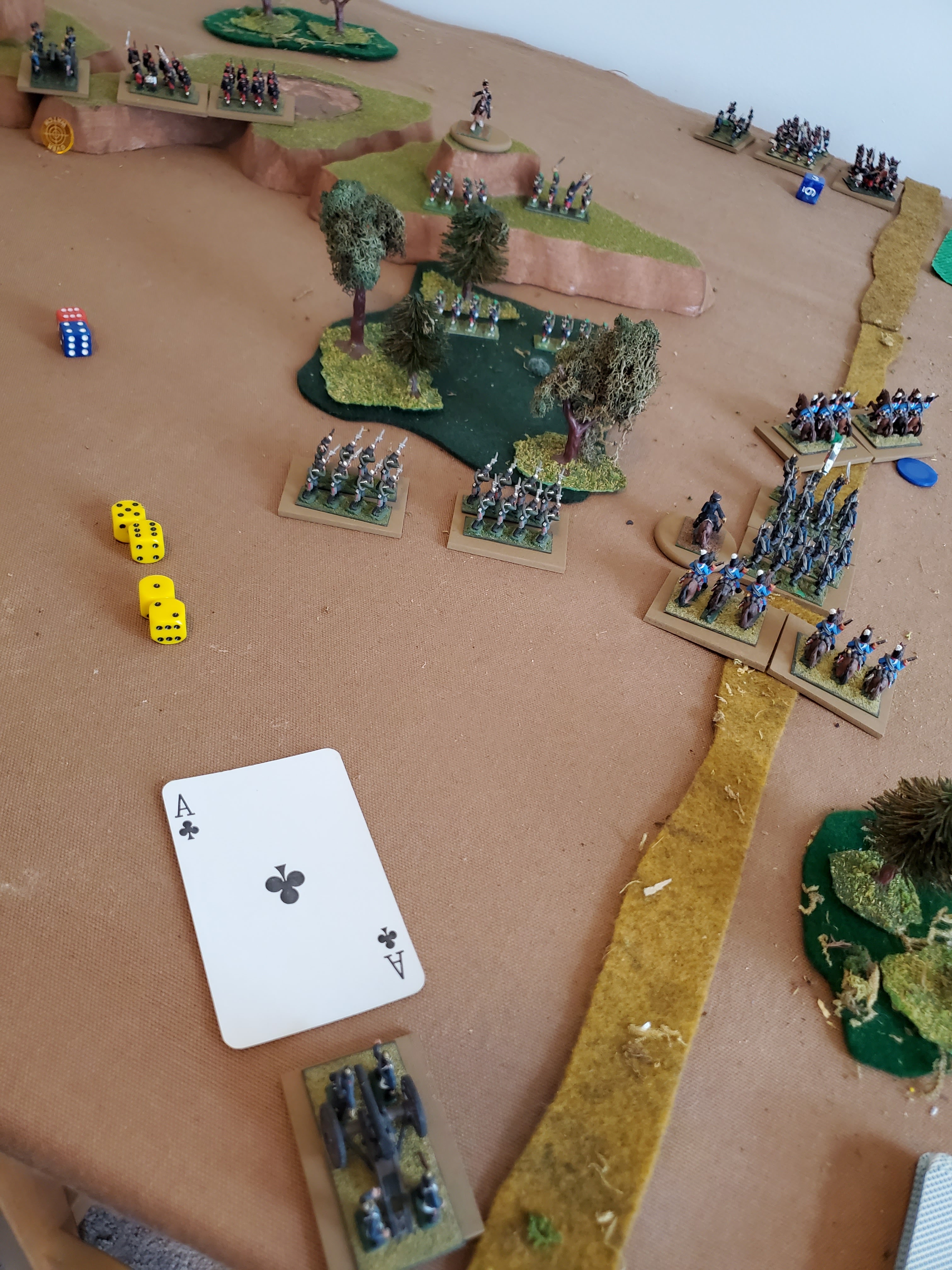
The Prussians enter on the road and move quickly up it, attempting to clear and secure the woods that are the key to the position; from them, they can establish a base of fire to clear the French off the hill. They send one cavalry as far as possible to threaten the French left flank - which only has light infantry - supported by Infantry and the second cavalry. The other infantry takes on the woods frontally while the Krupp gun works to establish fire superiority and drive the French gun off the hill - spending a valuable Ace for a second round of Fire against the gun, killing half the crew. Clearly, I opted for the Second plan from above...

Prussian Card Cycle 3, another Ace appears! 
The Prussians take a second activation to position their cavalry for a charge on the flank or rear of the French lights on the hill....
But the French spend a card to turn the lights around, move within 6" short range and shoot, then the Ace to shoot the cavalry again!  The Prussians lose 5 figures out of 6. Being a small unit, the Squadron of Lt. Dragoons is not much use anymore. The question becomes academic when they fail morale and Run Away. First blood to the French!

Well, this certainly demonstrates the danger inherent in the card deck - at least until the Aces are spent!

Speaking of which, another red card comes up, and the French Infantry on the hill realize that they will soon be pecked at by the Krupp battery, so advance off the hill, then spend the last red Ace to shoot the Prussians engaging their lights in the woods - with deadly effetct!

Prussian Card Cycle 4 arrives, bringing the Prussian reinforcements onto the table. Note the Prussian losses - the lt dragoon squadron and a stand of infantry.
Soon after, French Card Cycle 3 arrives, bringing the French some important reinforcements.

At this point, it is worth remembering that the two sides are not necessarily on the same activation cycle. The Prussians managed to get in an additional cycle over the French. So instead of the French reinforcements arriving one "Turn" ahead of the Prussians, they are arriving first for the Prussians, and the Prussians can spend face cards to bring the entire bunch on at once. Note that the French can do the same.

It is worth emphasizing that - in my humble opinion - A Gentleman's War requires a player to work very carefully to maximize opportunities that the card deck brings, especially with the use of Hold Cards. Once a player's used all his Hold Cards, his units entirely depend on the card draw off the deck until the Joker's arrive and new Hold Cards are drawn. 

It is a very interesting turn sequence, and definitely gives the game some unusual [and realistic] dynamics above and beyond a *definite* I-GO, U-GO turn sequence. I like it, altho I lose track of things sometimes. Others may not like it as it disrupts skillful planning!  But I think it takes skill to manage the cards...

Another note: the way the turn is broken up can make the game feel a bit small and skirmish-y at times and that each unit is about a platoon, a troop or one gun, much like The Sword and the Flame. However, the use of Face Cards to move "brigades" can make it feel larger again. This interesting effect can be emphasized by reducing the number of face cards or number cards, so I think the game is quite easily customized to the level of combat you desire.

As the cycles continue, the Prussians use a Hold Card to push on the French left, threatening the French voltigeurs [lights] flank with a charge....
...but the French counter with a higher Hold Card...
...and use it to put face and put a Hit on the Prussians first - not enough however...
The French having played their final Hold Card, the Prussians can now have their way a bit. They charge the lights, take some Hits closing in from defensive Fire, then go into Close Combat.
In a shocking bloodbath, both sides roll lots of Hits, but the Lights are Beaten and Run Away, 5 to 3 Hits. 

The French get some revenge as their reinforcements enter the table, and the famed Marvelous Mysterious Mitrailleuse Machine vents its wrath! It only causes one hit, however, which the Prussians save. 
Of course, it jams, also.

As Card Cycles Prussian Five and French Four come around again, the Hold Cards heavily favor the French, 2-1. 

The French ligne infantry roll some devestating chassepot fire!
But the Prussians easily hold their ground on a '6'.

Card Cycle 6 comes around for both sides as the Joker arrives.

Both sides try to use a Hold Card, they tie on the dice off...

Then the Prussians win and advance into Close Range. The French then get a red Ace and blast the Prussians down to 50%. They roll for being Disconcerted and a measly '1' gives them a "Run Away" result...
...they roll a '12' for distance and are off the table. That hurt!

Prussian losses: Cav Squadron, Infantry Battalion, and a couple of companies.

The Prussians now decide to make a push on the center, the rallied lights, partially crewed gun and strong battalion holding off a battalion and a half of Prussians.
The Prussians add their Heavy Squadron reinforcements.
Charges are made against the gun...
but four French light squadrons arrive French Card Cycle 6.
Hold Cards are played to get the edge against the opposing squadrons
Prussian cuirassiers and French Hussars are all falling back, along with the French gun.

The other cuirassier attacks the French infantry, supported by the Prussian infantry, but are wiped out by defensive fire.
French hussars charge and destroy the last Prussian in one battalion, and their general.
But the Prussians then shoot the hussars to pieces. To their right, you can see the Prussians who have now forced their way into the woods - almost two battalions.

Card Cycle 8 for both sides, after Jokers.  The hands are even in size but favor the Prussians in quality.

A few more cycles passed, but it was already clear the Prussians weren't defeating the French much less clearing them from the hill. They advanced onto the hill but the French reinforcing infantry on the other side were able to shoot them off it. Meanwhile, the to-ing and fro-ing in front of the hill exhausted both sides, and the French ended with a draw in their favor.

The game was eventful and flavorful, but with ten units a side took a few hours longer than anticipated. Given the scenario and the Card Cycle I was on, the outcome was not certain and with 1 Card Cycle = 1 Turn there were possibly seven more Turns available.

THOUGHTS...

A Gentleman's War is full of movement and action. Depending on the cards, it is usually punctuated by short sharp events with plenty of drama rather than coordinated activities by mutually supporting forces. 

While I can see how proper use of face cards to activate a "brigade" of up to four units can bring a decisive local result. However, these don't fall like leaves and if there is a run of number cards the action gets a very choppy and skirmish-y feel to it that doesn't suit a Unit = a Battalion action of a couple of brigades per side as I played here.

This is quite different from a phased game where all moves, shots then melee occurs. It can also be hard to remember what happened if you are interrupted [ah, family] or forgot to mark a unit as activated.

Aside: I wonder how the turn sequence would play as a skirmish game with one fig = one unit??

Firepower is relatively weak, intentionally per the design notes. But with any weapon - musket to breechloader - a large infantry unit has little to fear from a frontal charge from cavalry. Close Range Shots hit on a 4+ with all weapons, which is almost always the same 6", "capping" small arms effectiveness. This could easily be tweaked for more realistic firepower to a 3+ or even 2+, which in turn could be offset by more terrain for more late-period feel and challenges.

The game is entertaining but not quick. Each event involves a couple of steps and some looking at the rules and charts to calculate situations and modifiers and such. While the mechanics are easy to understand they slow the pace of each event. As such, they are more of a day off sort of game than an evening at the club sort of game, especially with new players or sides of several people. 

Interestingly, I can see it easily scaling up and down using no change of mechanics:
  • 1 fig = 1 man with doubled ranges makes a Unit a squad.
  • 1 fig = 5 men as is makes a Unit a platoon.
  • 1 fig = 10 men and halved ranges makes a unit a company.
Thus, with the one set of rules, you can play colonial scraps from a platoon patrol to a battalion action. I haven't tried all these bright ideas yet, but it has me rethinking plans for my 15mm French Foreign Legion v. Arabs....