How Men of Quality Resolve Differences

How Men of Quality Resolve Differences
Pudel and Peper attacks - an ugly but inevitable part of any 17th C. British Civil War, "Oh! The Shame of it All!"
Showing posts with label Hobby Skills. Show all posts

Monday, April 27, 2026

Mounting / Basing FPW Cavalry

Every Gamer's Favorite Pastime - BASING!!

As the basing program continues, I am pleased to report that I've based a full division for each side, enough to run playtests using the latest draft of the rules.

However, there are still over 100 cavalry that are not assembled and based, and need some touch-up painting as well. These were reported MIA at the time the armies were acquired, and then turned up later, for which I'm grateful. Below some French Guides [I think - they are painted as Guides albeit partially incorrectly] are finally saddling up!

My uniform sources indicate that they were [expensively] mounted on bays.  So be it.  From the mass of partially painted horses I selected some lighter brown tones.

To get the superglue to stick better, I scraped the paint off the spots where it'd sit.
That included scraping it off the horse blanket.

To get the rider to fit on the back, I had to cut off a portion of the reigns - this improved fitting as the left hand is snug against the remaining end of the reigns.
I tried a couple of ways to cut, and a rocking motion in the direction of the blade was best.

I'd then continue the cut to take off the paint on the horse's back.

As can be seen, some painting will have to be cleaned up later - for now, I just want to get several more squadrons mounted.

It is a sort of mindless step, requires concentration but no thinking. They look good as they mount up! To the right are the next cavalry - two squadrons of Prussian lancers. Guides and lancers are very FPW unit types.  The lancer fad started in the later Napoleonic wars, and despite plenty of disagreement about their effectiveness in various circumstances, were used by all the major powers of the 19th C.


Once they are all glued, I rinse them gently in warm water to get the dust off them, cleaning them with a very soft cheap paint brush in a closed sink [in case a rider falls off!].

Once dried, they are definitely a bit brighter without dust.

Sculpted with significant moustaches in a dashing pose!


I had some issues getting them off the wood, included a few riders popping off.  These had to be super-glued back on.

But the end result after basing is solid.  Two more squadrons of French Cav.


Hope that seeing some of the techniques used is helpful to the viewing audience.  Any additional suggestions, do comment below!

Next up - Prussian Lancers.

Wednesday, September 29, 2021

Envisioning the Battle Plan

Sometimes you just need to stand there and think...

Right now, this guy has got to scale down his game and think about getting more figures!

So, wargaming like generalship takes all sorts of minds.  Some are good at creative thinking, some aren't.  For those of us who need to _see_ what something looks like on the battlefield, there is military wargaming [TEWTs, sand table exercises, etc] and there is playtesting.  Sometimes we don't have time for a full playtest, but we can set things up and move them around.  This has an added advantage that if one isn't playing the game for a result the thinking and planning process is smoother and easier to focus on.  I know that even when I play solo, I sometimes get carried away with how the battle is going and forget to document, take pics, etc.  Don't you??

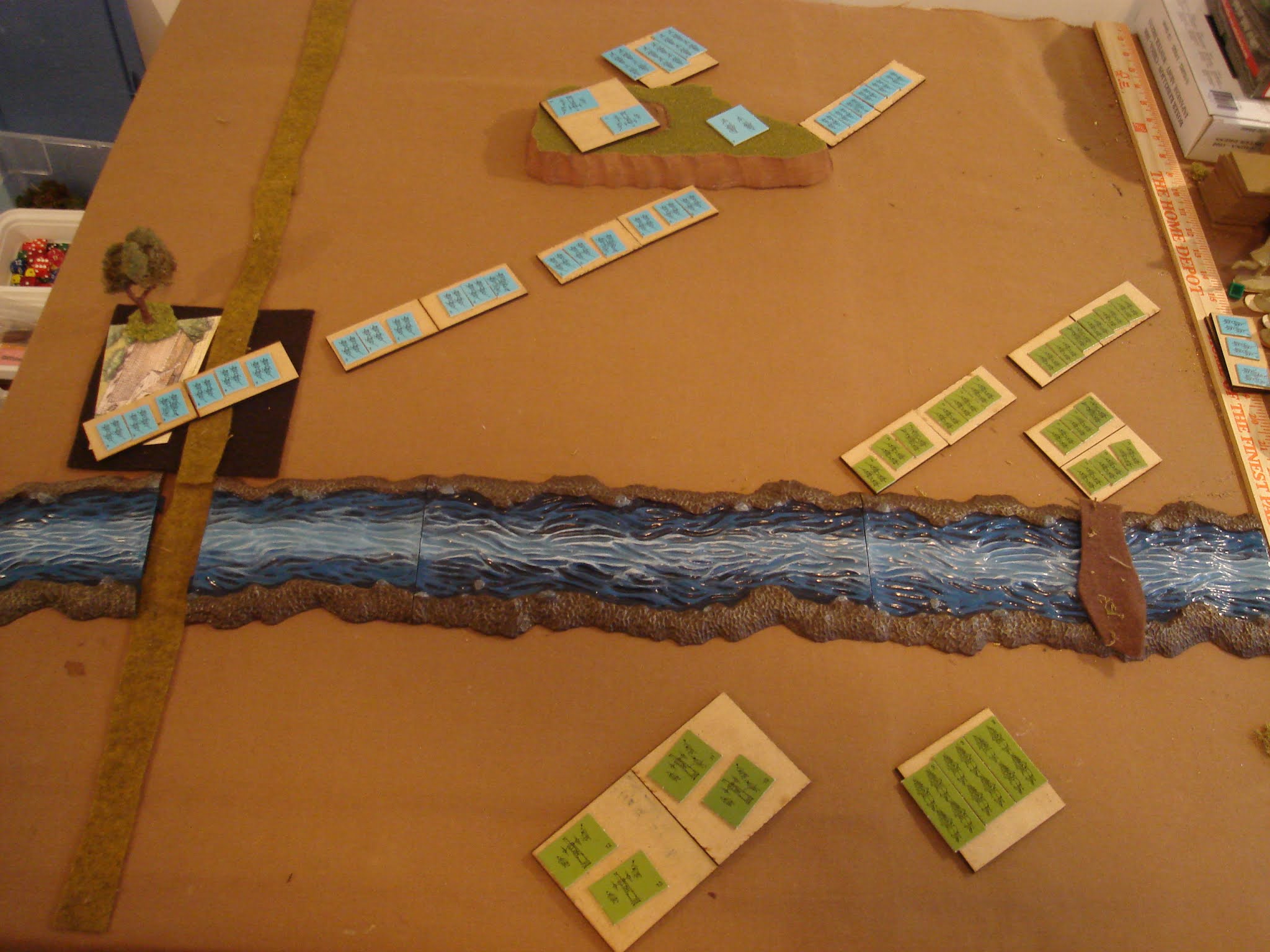
Here, One-Hour Wargames scenario 12 "An Unfortunate Oversight" returns as an opportunity to "Envision the Battle Plan".  This post is strictly using the OHW RAW and therefore infantry are 6" wide, guns, skirmishers and horse 3" wide, with 12" shooting ranges except for the 48" for guns. 

In the below image, we see what may be an optimal situation for the defender, with a pretty continuous line of defense - the hill cannot be outflanked, the guns can hit everywhere except where the town blocks LoS, and the cavalry and infantry on the other flank are able to advance and contest the ford.  Only problem is that the defenders set up within 12" of the town and will have to spend time moving to get to these positions, at least 2-3 turns.  Still, it helps us envision what a broad if shallow defense of the hill would look like.
If the Attacker - Green - begins fording the river, they are within shooting range of the guns the entire time, and from the infantry within a couple turns.  There isn't space to deploy without being in range of at least some defenders who are on the hill.
However, the Attacker in this force roll-up has two batteries of Guns that can help pave the way for the fording attempt.  The cavalry will protect the guns from an attack out of the town as cavalry may not be a great choice to ford a river under heavy fire with enemy cavalry support on hand. The Attacker's guns can destroy or drive into hiding behind the hill the defender's battery, and probably damage an infantry unit in the bargain.

Below, an alternative to having the entire force under unanswered fire from the Attacker's two batteries.  The defending infantry in the town and just over the river are likely in range of the gun batteries, while a portion of the defending force is behind the hill entirely.  The Attacker only has his three infantry units to force the issue and attempt to take the hill.  With the defense fully engaged, this would be tough for the attacker to win. Also, the positioning is about right for Turn 2-3 for both sides according to the setup rules.
An even more conservative version of the above plan.  The defender has half his force behind the hill, while his guns shell the advancing three infantry.  At least one of them will be damaged and vulnerable to a counterattack by the three defender's behind the hill, which have the option of attacking with a swift charge from the cavalry or using the firepower of the infantry.  From the town, both infantry can easily hit the gun batteries which have to decide to shoot at them or support the main effort while getting fired upon without responding.  The Attacking cavalry is not doing much here. I like this plan for the defense!

Below, the defenders are using a combination of the above plans, with more up front, while the Attacker has moved his guns away from the defense, and positioned the cavalry to ford the river or advance and protect the guns from a sortee by the defender's there. This would be a great little scrap, I think.

Should the defence want to sortee from the town, their supporting infantry would need to advance...
...while the infantry cross the bridge. The guns are threatened but at least one battery can fire upon the attackers [who can't charge in OHW].
The Attacker's cavalry would have to advance and charge the infantry. Hopefully, the guns would have inflicted some damage to them, and the cavalry would eventually knock them out.  I don't think this is worth it for the defense since the victory condition is the hill that is now far, far away.

Below, the defender's swop out the infantry in the town for the guns. OHW doesn't allow guns to set up in a town, but perhaps your modifications do? Or perhaps it isn't a town but a fortification?  An interesting alternative.  Attacking the guns in the town isn't a great choice as they'd fire full effect and take half hits in return.
But perhaps the cavalry would be in a mood to do something extraordinary?  If they charge outside the arc, they would get double Hits canceling the half hits of the town / fortification, so might work.

Having explored this possibility, the below is probably the best plan, with four maneuver units crossing the river to attack, supported by the guns. The two batteries should be able to damage the infantry unit at the point of attack.

Attacker's setup - all infantry preparing to cross and fight, with cavalry nearby.

Turn 1, working the way across the ford at 6" / turn.

Turn 2, expanding the bridgehead.

Turn 3, formed up, but a bit outflanked...will need to spread out a bit, probably to the right so that the guns can keep up the firing.

By laying out the forces, measuring some distances, and watching how fast it takes the attacking forces to maneuver, we can get a pretty good idea of how far they will advance before contact, how many hits the supporting guns will inflict, and a few ideas of choices for the defense.  While the setup will determine what some of this looks like, we will definitely benefit from pondering the possibilities in advance when preparing for a game, especially if we are the game host.  

All of this took about an hour to setup, think about, and write down some notes.  I'd feel comfortable playing this scenario with the preparations I've made at this point.

This method could be used to ponder any of the scenarios when you don't have time to play a full game, or you just want to set up ahead of time and are waiting for your opponent to show. I can't think of any OHW scenario where this wouldn't help.

Hope that this shows you a few of the tricks of the trade that make for success in any wargaming endeavor, whether for fun or for the profession - happy gaming!

Saturday, August 22, 2020

Wet Palette - just say yes and do it!

Well, I had heard of a wet palette a few times, but never really looked into it much. Then I stumbled across a couple of videos while searching for something on prepping soft plastic figs on YouTube.
https://youtu.be/96mjmqWTPfM?t=215
Altho the guy could explain it in 3 minutes, he spends some time explaining why it works and why you should have one. I've stopped it where he discusses the 3 minute process of making one.

Seems like a good series, my main prob is he's drunken deeply of the GW kool-aid. Anyway...

Fast-food plastic container, 3 layers of paper towel and one layer of parchment paper [build time 2min 23 seconds-ish]:


Voila! the center is a flesh wash of vallejo light brown, off-white and old Polly-S flesh. You can see how the moisture causes some beading you can use to thin the paint. You can also tell where I put my paint drops then pulled them to the center to get a few slight variations of [Caucasian] flesh:


Chap below is on the darker side, caught some sun:


This fellow is over white, but the paint performed well:


His pal just arrived from 'Blighty.


What I started with, the unmixed Polly-S flesh tone:


Even on black prime, this flesh mix was very smooth and coated well. Overall, a bit too much paint, still.


All sealed up. Will see how long the paint lasts. it's supposed to keep for several days with this palette.


Overall, I can't see not using a wet palette in the future. I made a couple more as this one is a bit small once you start spreading out the paint for a mix.

I can see this will make it easier to paint, give better mixing and coating with a thinner layer of paint, and save it a few days so it doesn't dry out, allowing me to return to a project multiple times if interrupted [all too common these days].

So I say - make one and try it out!

Tuesday, May 28, 2019

Franco-Prussian War: Grand opening preparations!

Battle of Columbus' Nuts?
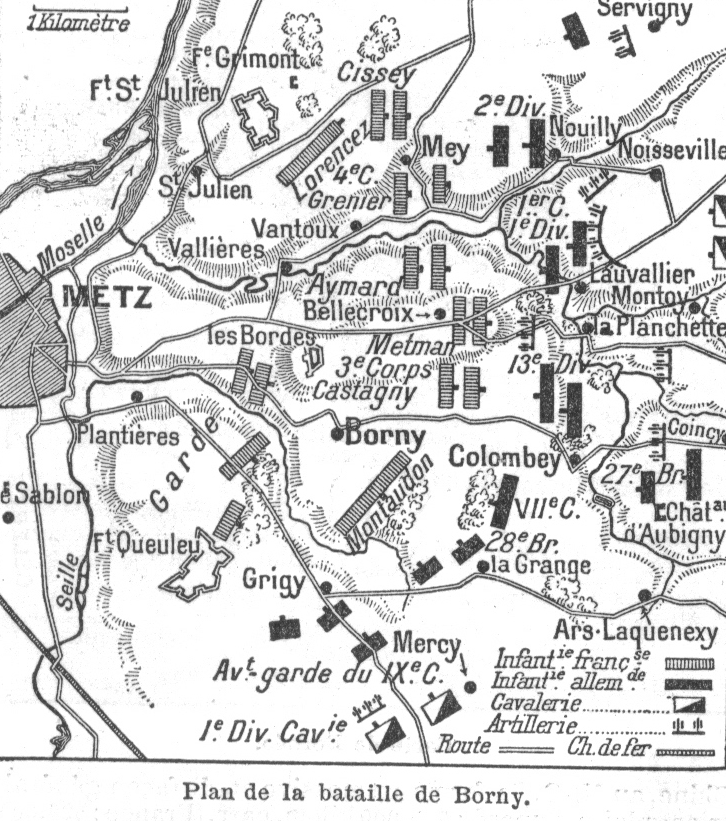
Bataille de borny.PNG
[link] Plan?? Who said we had a plan!?

Colombey-Nouilly [just East of Metz] is an interesting battle. Unfortunately, it's not the right battle for an initial intro to the game for an unknown size group of players, but I like the terrain. There are a series of ridges or fingers running East to West that terminate in a series of valleys, and I think the terrain is complex enough to diminish some of the effects of fire and give plenty of maneuver room.

The above map of "battle of Borny" doesn't do the terrain justice, so I'll have to show another map, this one from Bruce Weigle's superbly researched "1870" rules:
In essence, the Prussians are attacking West down a series of spurs from the larger mountain chain to the East. These appear to be "fingers" descending from heights on the right. The above map is about 9' x 6' of table. 

The multitude of streams running down the valleys between the spurs indicate the terrain scale.  The grey patches of hashmarks are vineyards, woods are the usual shape. Overall, this is pretty dense terrain and this terrain scale is usually not properly presented on a gaming table, being overly simplified due to a lack of terrain items in the host's collection and the general trend to simplify.

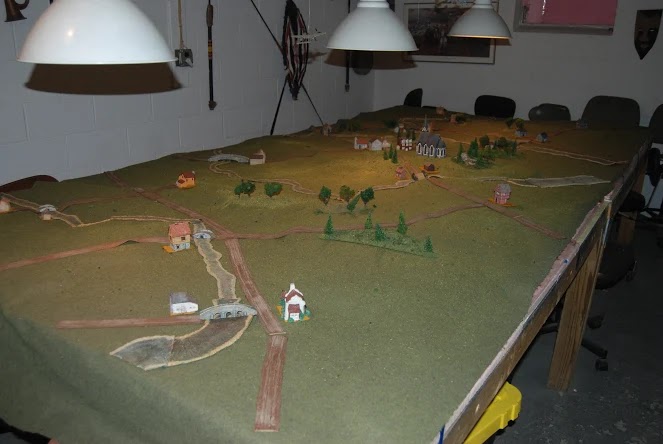
Host has super-cool and very well thought out terrain system using pink insulation foam about 1/2" thick, more than enough for his entire 12'x6' table. He piles up the levels then tacks a felt cloth down at the contours. Works really well; the only issue is that the scale of the hills is about half what the game scale is, i.e. they are twice as large as they should be - or more. The height is fine, but the hills are very long and gentle compared to real hills, i.e. the terrain of the battlefield. Still, the net result after we set it up really looks great!

Only disappointment with these pics...the heights of the battlefield - ranging from 3-5 levels up - are lost in the texture and color of the felt covering. The actual setup looks pretty dramatic live, and the contours are pretty easy to see.

In the event, I reversed the table sides. The Prussians are attacking "East" [the Prussians attacked from EVERY direction historically, so no problem there!] so we'll say that this is a view from table SE

View from SW [Metz is just a few feet off the table to left]

From from NW

View from NE

View towards East [so Prussian viewpoint], North end of table.
Some of the contours are a bit more visible here - as well as the blue push pins that are holding the felt into them.

Prussian view to East, Center of table. The scenario will start with the town half occupied by both sides for immediate action.

Prussian view East, South end of table.

This is a great table system, well thought out and on a large scale. While it is out of my league, I'm certainly going to copy it on a smaller scale!

This does introduce a major challenge of gaming - getting the terrain at the correct scale for the game and the real terrain of the battlefield. Most gamers fail here, as it is itself a time-consuming endeavor to create and present good gaming terrain.

For example, the ridges of terrain for this battle are about 1000m [10"] wide, and the contours are around 2-400m [2-4"]. Overall, our table's dramatic spurs and descending ridges are about double that width, and most of the contours more gentle, again about double the distance between them. I don't think it would be really difficult to replicate the terrain more accurately, it just requires a different scale, and I think the table as it stands has been designed more for 25mm figures.

Interestingly, I have a series of styrofoam terrain that is intended for 25mm games, and will probably work a bit better, if not perfectly. Ultimately, I will make some terrain pieces in the correct scales as they will work well in 15mm whether WWII or Franco-Prussian War. But that will be a project for later.

Suffice it to say that as good as it looks, there's probably half as much terrain as needed to reflect the real battlefield, and it is at the wrong scale. Still, this is good enough to get us started and intro the Wednesday Night Grognards to the game.

Next post - the battle!