How Men of Quality Resolve Differences

How Men of Quality Resolve Differences
Pudel and Peper attacks - an ugly but inevitable part of any 17th C. British Civil War, "Oh! The Shame of it All!"
Showing posts with label American Civil War. Show all posts

Tuesday, November 3, 2026

K&P Goes B&G

A great scrap with new uniforms and amateur optimism;
not the first time a war would be "over by Christmas"!

In a never-ending search for the perfect rules, we gathered to satisfy the unhealthy obsession lively interest that The Angry Dachshund [click] has with the opening battle of the ACW, First Manassas. 

First Manassas. This is an interesting battle, characterized by lively aggression, adequate leadership, and decent planning on both sides, overall.  My personal opinion is that McDowell's plan was unrealistic for green troops and leaders to accomplish in heat and heavy terrain. He probably should have just picked a crossing point to slug it out and grind the Confederates down...but then he'd be Gen. Grant, I suppose!

Rules. Steve had  been working on an ACW adaptation of my "Kepi & Picklehaub" rules - themselves an adaptation of Neil Thomas' inspiring "Wargaming 19th Century Europe" rules. For NT fans, these represent his best developed horse and musket rules for his "4-base systems" that started with "Simplicity in Practice". Worth buying if you're a fan of anything from SiP to the machine gun era!


Player Level. The "Wargaming 19th Century Europe" mechanics provide good "feel" for Player = Division / Corps Commander level of play. You can see the fight developing, troops advancing, standing or retreating, but the nitty-gritty of why things are happening at the lower battalion and company level isn't there and  doesn't bog the game down with unnecessary details. This is tricky to get right, and NT manages it with modest amount of rules using nearly zero "novelty mechanics". I'd like to shake his hand, but apparently he's something of a recluse...

My spin on it, "Kepi & Picklehaub", adds some period nuance and pulls in the rally mechanic from NT's "Wargaming: an Introduction" ACW rules. Altho it is focused on the FPW, there's no reason for it not to work in a "Blue and Grey" version with a few changes. But this would be the first time we actually did it.

This battle had a lot of discussion regarding mechanics [and a lot of fun sidebar conversation] so it was played over multiple sessions. Steve had a lot of questions, inputs and mods, many of which were really quite interesting to hash out, and I was determined to stick with him in his obsession project.

Map
I'm not going to rehash the historical battle as there's plenty on it in books and the internet.  But it was a fluid maneuver battle, and therefore interesting to game for anyone who wants more than a simple slugfest. McDowell had an interesting plan that that spread the fight out, so it is also easier to play with a smaller figure collection.
from https://www.military-history.us/2014/08/the-first-battle-of-manassas-21-july-1861/

Below, for those who want "the big picture" is the full map from above source.

May 25th Session
With the figures he had on hand, Steve wanted to fight the main fight, the one focused on Henry House Hill.  So we are viewing HHH from the North, Matthew's Hill, from whence the Union attack is coming. From the left, Confederates Bartow - Bee - Evans [top] are facing Union Wilcox - Burnside - Porter [bottom]. I admit to perhaps mixing up the exact brigades... Visible at the intersection, atop the hill to the right of the house, and farther to the right on the hill, are the three red beads that denote the victory points - winner is whoever has the most beads / points.

Below, Union troops rapidly flank the most forward confederates in a classic "hammer and anvil" approach. The battle lines are quite fluid in this battle, making for an exciting game!  Steve's Rebs are withdrawing in pretty good order, and he is avoiding making the mistake of letting me trash some exposed troops with my mass of Blue-bellies.

View from the Reb west flank. I am - literally - pushing as hard as possible to extend and thin the Reb left.  K&P allows troops that are not close to the enemy to march a lot farther. Thus it really pays to have light infantry and light cavalry out in front, constricting the enemy maneuver space. Again, this is a NT "Wargaming 19th C. Europe" rule, but one that I think is both familiar to many wargames / wargamers and quite realistic.
Above. Despite his left being obviously outflanked, Steve keeps his nerve and - just like an Angry Dachshund, hangs on to HHH with determination.

Basically, I'm pushing an entire brigade around the Confederate left....

Below, by advancing as fast as possible, taking a few risks, I manage to dislodge the Rebs from a more determined defense.  I really want the red bead at the top right, as I think the HHH bead is unlikely, and the crossroads is a certainty! While we both make a few little errors here and there, the inevitable difficulties of facing superior numbers maneuvering well is making the Reb's life difficult. He can't get too pinned in the front, or his flank will collapse.  He can't get to spread to the flank or the front will collapse.  So far, Steve's doing well, especially given the numbers of Union regiments coming at him.

As may be apparent, looking closely, while the guns are 1-base batteries, just like W19CE, Steve's regiments are on three bases of about 8-10 figs.  We did a few simple adjustments to the rules to accommodate this. First we used my "strength point" concept that assigned fixed values to Bases regarding the number of hits they could take.  I think it was 3, but maybe 4. A red die indicates that the regiment has "lost a base" in typical NT rule terms. It only has two left, however, not three.  Rallying and shooting similarly take into account his basing, which shows how flexible the rules are; one doesn't have to even use 4-base units for Neil Thomas' 4-base rules!

Anyway, the game plays - overall - much as you would think if you took the W19CE rules and added the Wargaming an Introduction: ACW mechanic for rallying.  Overall, a lot of depth for minimal rules overhead!

Below, The Confederates are being steadily outflanked as they try to hold a strong point in the woods.  I'm trying to keep the Union forces organized for both fighting and rallying. This way I don't lose regiments, but keep the pressure on his flanks. Overall, it seems to be working, and I think I'm inflicting more damage than I'm taking and - more importantly - I'm able to rest and rally my units more than he can.

Meanwhile, on the Reb left, the forces are looking thin indeed!  I'm racing to outflank him while he's racing to support his left... but he has a central position, and I'm flanking him through rough ground.

This ended an exciting and eventful session.  We figured out a lot of the mechanics we'd keep and a lot that we'd tweak a bit, all on the fly while playing, so it was also good clean fun.

May 29th Session
More Union arrive on the Rebel right, this time - Sherman, I believe.  They're being outflanked everywhere, operationally speaking this is a great Union attack! However, he has been reinforced by - I think - Evans' brigade. Steve has one unit holding off a lot of uncoordinated Union troops, Burnside center and Sherman at left [top].
At bottom, real pressure is being brought to bear on the Reb regiments - one is at two bases [of three] lost.

But more and more troops enter the fight on both sides.  And it seems the Reb's bacon will be pulled out of the fire for now, as reinforcements arrive at the point of contact.
Overall, since I'm pretty familiar with these rules, I'm coordinating well but there's always a hiccup or two along the way.  Guns lag behind their brigades, while I try to sort out troops and guns and keep brigade integrity solidly near their leaders. That's not easy to do in a maneuver battle!

Meanwhile, on the left of Henry House Hill [HHH], the Rebs of - I believe - Stonewall Jackson's brigade have arrived on the scene. They moved a lot faster in the open without any Union lights or cavalry to slow them down than the Union could in the rough ground and woods. Still, I'm developing solid firing lines and banging away at the Rebels as they arrive.  I also have more to spread out and continue the attempt to outflank him.
Also, I'm trying to rally my hits off whenever possible, an advantage of having more numerous troops in the scene.

June 13th Session
In a bold - unwise? - move, the Union reaches the far end of the table with a couple batteries. As the fight down teh roadway is mostly evenly matched, two batteries adding in their firepower could be decisive, given enough time. 

Meanwhile, at Henry House Hill, the Rebs have put together a pretty solid defense.

On the Union left, Sherman et al are keeping the Rebs tied down.

Finally, in a stunning turnaround, the Rebs take to their heels, retreating behind the bead!  Union has won the fight at the road, and now needs to secure ground with the best regiments possible.

At HHH, two lines of Union regiments surge forwards!  I gave up on trying to turn their right. With the crossroads in hand, and their left flank being forced to withdraw, the center has become the place of greatest pressure against the Rebs.  This prevents them from supporting their left, so the Union is likely to end up with 2-3 objectives given enough time. 

The confederate right is doing just fine, however.

An interesting series of games and game design discussions. A lot of it was distinctly focused on game mechanics. Much of it was similar to concept and development for the Kepi & Picklehaub rules. 

Overall, I felt like the "Wargaming 19th Century Europe Rules" are a good fit for ACW - all you have to do is use lots of green units [not all, but lots] and the rally mechanic from Wargaming: an Introduction - ACW.  The table needs lots of terrain and little cavalry, usually.  In this way, a "typical" ACW battle can be played out.  Also, using the occasional smoothbore and / or breechloader regiment will add a bit of variety.

W19CE should be called "Wargaming Horse & Musket" as it can easily cover anything from the use of musket battalions to Zulus [using the mob rules].  I think NT's editor pigeon-holed the rule set, and with little changes to the rules but lots of different battle coverage NT could make them go from Blenheim to Basutoland. All the mechanics you need are in this final, most developed set of rules that NT started with "Simplicity in Practice".  I highly recommend ANYONE with interest in the horse and musket period pick up this book.

Conclusions
1) The use of Strength Points per base and varying Base numbers per Unit makes for a simple, easy change of feel.  Units can be made more durable or fragile.
2) The Rally mechanic [especially when combined with a "Fatigue Level" that limits how much you can rally back] provides for an easy, realistic measure of "rest and replenishment" cycles, a tactical pause for the men to catch their breath.
3) No figure / base removal means units continuously occupy the same space altho they lose combat effectiveness. This enables fresh troops to have a realistic advantage in a given Battle Space of the table.

ACW distinctions
- Lots of heavy terrain; woods and deep linear water features.
- Linear combat, column movement [column is not a fighting formation]
- Many units have low morale, and it is likely they will Fall Back or Retreat. After, they are able to rally and possibly return to the fight. Ergo the side with the most fresh troops skillfully handled to keep up the pressure will take ground and seize the key objectives, causing the enemy to retreat from the field.

Saturday, April 30, 2022

American Civil War: It's "Epic" now!

Epic v. Kallistra Comparison

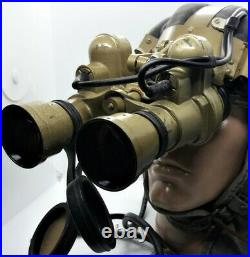
Was able to quickly sell off all my 6mm ACW figures - I had to, they were just too small to see or deal with for me! After struggling with various optical enhancements:
I gave up and eventually listed them on Fb where I was pleased to find someone who was glad to have them.

Still, the ACW is near and dear - and I like it at the regiment / battalion level.  I wanted a look that gave the impression of a long line with lots of Soldiers, but was larger than 6mm.  I was very interested in Old Glory 15s, which look perfectly animated for this period.  I also closely looked at Old Glory 10mm, which appeared to be quick to paint up and yet still look right despite the blocks.

A gaming pal told me about the new Warlord Epic scale [somewhere around 13mm or True 15mm, or...something], I did some research and found the starter box at a discounter for... $108.00, so it was a no-brainer!  Also, the plastics snap into bases and I can playtest while I am painting, which was a big bonus. I quickly bought it!

But, I'm picky about a lot of things I like on the table, so I just had to expand the offerings with Kallistra's "12mm / 1:144" figures from here [CLICK].  They appeared to match up well to the uncertain scale of Warlord Epic.  This allowed me to get skirmishers, cavalry, more gun variety, limbers, wagons, etc. Things I needed for both game mechanics and appearance.

Box arrives - couldn't resist spending a few bucks on flag sheets, they are just too useful!  Amazingly, the simple packing survived altho just barely.  They should up their game in this respect!

Comparison shots:  Kallistra gunners v. Epic: Kallistra are a big "bigger" and Epic are a bit taller and are slender. Overall, while the style is different, on the table there will be very little difference to the eye - especially at 2-3 foot gaming range!
Above, the Kallistra wheels are the right type [16-spoke] and only *slightly* smaller. The gun is the same 12 pound Napoleon, and the barrel is definitely smaller while the carriage is a bit smaller and more slender and otherwise close.  Once painted, I'll see which guns will stand in for what types.

Below, closeup of the Artillery.  The plastics are very cleanly sculpted and executed, the Kallistra have more texture and wrinkles in the uniform cloth. This may differentiate them more from Epic to the eye than any size issue.

The Cavalry. Pictured are Kallistra 12mm / 1:144, Epic, and 15mm Rank and File Prussian Cavalry from here [CLICK].  The difference here is quite pronounced.  As cavalry can take up a lot of space on the game table, it is my thought that I prefer the smaller Kallistra.  How do they look next to the infantry?
Another shot - you can see that the Epic are almost as big as the 15mm fig, definitely between the Kallistra 12mm / 1:144 and the Rank and File 15mm.

Below, how does Kallistra compare to Kallistra? Certainly, the height is right - the cavalry are significantly taller. My thought is that the horse is a bit short and doesn't have quite as much bulk.  I'm fine with this as they are more likely to be pony nags than cuirassier steeds in real life!  The Army was notorious for inconsistent horse purchasing.  Ultimately, they are intended to mostly serve as mounted infantry, so as long as the horse can keep up the pace, it is good enough.

Same comparison with Epic in between.  The stands are not quite right, the Epic is a bit heightened by 1-2mm thanks to the stand v. the cast base of the Kallistra.
This is a better shot - all cast/molded bases are about equal. The Epic has less bulk [and less gear] than the Union infantryman, but both are close in height and obviously shorter than the Union cavalryman.

Overall, I am very happy with the project.  Altho the Kallistra set me back $315, the Epic "cast of thousands] provides a crazy number of 60mm stands, 120 to be exact!  In my world, that translates to about 40 units!  The Kallistra flesh things out just a bit with infantry [Zouaves, Heavy Artillery infantry unit] some gun variety, and most important, the full cavalry option [mounted, dismounted with skirmishers] and skirmishers in general.

The big question now is how will they paint up?  My goal with 10mm is that it be a lot faster than 15 or 25mm painting, and obviously less expensive, while still obtaining the look I want on the table.

I'm hoping this is correct, we'll just have to see!

Friday, April 8, 2022

My "A Gentleman's War" Project, P.1

I've been knocking around the idea of an AGW project for a while. It's been hard to figure out what is the perfect period for such a stylish set of rules! My requirements are:
  1. Large figs with simple shiny paint: 40mm to 54mm preferably.
  2. A war that one struggles to take seriously
  3. Alternately, a "what-if" war; somehow, I prefer a "what-if" to an Imagi-nation war. It's odd, but while I love the Imagi-nation work of others, for me, it just doesn't work...if they're sorta Prussians, then why not just be Prussians??
  4. Given the nature of the war, the people and units must be ripe for humor. If COL Balderdash and SGT Whiskers can't march upon a field against Gen. Rimskey-Kutitoff and Prince Putinov, then why bother?
  5. There needs to be enough Figures that I like to motivate the painting.
Given the nature of the requirements, I came up with a few ideas that caught my interest:
  • The War of 1812
  • The Belgian War of Independence, 1830
  • The American Civil War, 1850
  • The Crimean War, 1853-6
  • The Invasion of Belgium, 1890-ish: precursor to WWI

THE WAR OF 1812


Pros:
  • Particularly silly war as few even understand why it was fought
  • British are Napoleonics; Americans similar
  • Figures in 40mm from Sash and Saber
  • Figures in 54mm are plentiful: mostly plastic Napoleonics; best are Armies in Plastic, which has Naps and 1812, Indians, ACW in kepi for French, and Crimean War cavalry!
  • Lovely crazy expensive plastics from Singapore
  • Shorter Range than ACW
  • No one games war of 1812, so would be "different"
  • Easy access to resources here in USA, including visiting Battlefields in Maryland and US - Canadian border
  • Much of the generalship was so poor, it begs for satire and whiskey
  • Several boardgame options
  • Comes with interesting naval actions that really matter
Cons:
  • Historically, hardly any cavalry actions
  • Did I say there's hardly any cavalry actions?
Overall, this is a great choice!

THE AMERICAN CIVIL WAR, 1860 OR 1850
This has a lot of potential, and is an favorite period all over, but especially in the USA. Also has interesting gaming potential as a "What if" on a smaller scale in the 1850s - the war came close to breaking out during a few crises.

Pros:
  • Figures in 40mm from Sash and Saber
  • Figures in 42mm from Spencer Smith
  • Figures in 54mm are plentiful: plastic ACW is everywhere; best are Armies in Plastic
  • Variety in weapons and Ranges: smoothbore carbines to breechloading repeaters, smooth bore 6lb cannons to 20lb rifled Parrots
  • Easy access to resources here in USA, including visiting Battlefields in Pennsylvania and Maryland
  • Some of the generalship was so poor, it begs for satire and whiskey
  • Infinite boardgame options, tons [literally] of books, a number of movies
Cons:
  • Not a very silly war because of slavery; politically loaded perhaps
  • Everyone games the ACW and has an opinion about it
  • Historical uniforms have variety but usually lack panache [except militia companies]
Altho I did look into the other options listed above, I decided to go the simplest route, and put in some quick orders through Armies in Plastic and Michigan Toy Soldier Company where I found additional bits and some nice Cavalry.

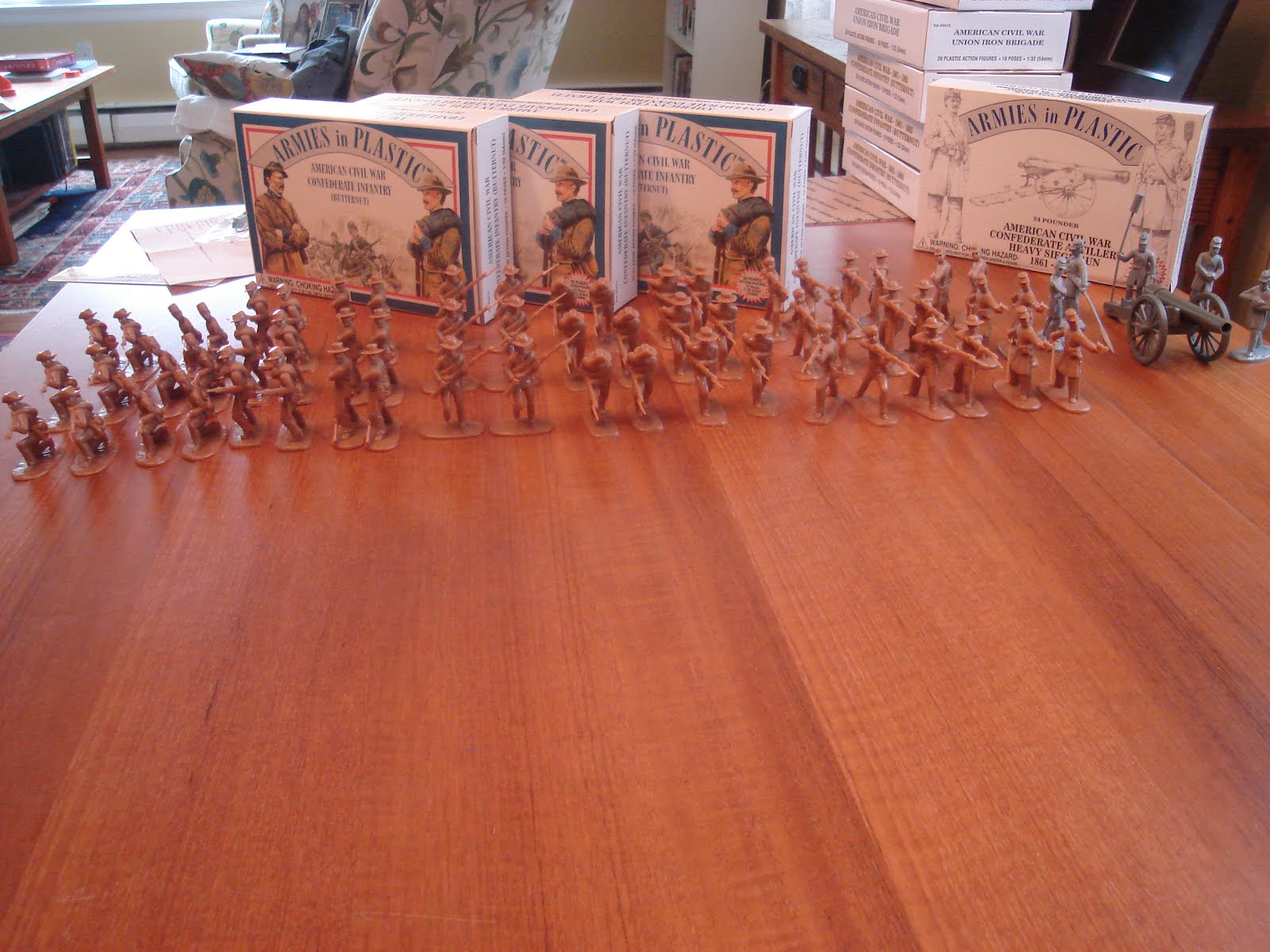
Below, the first order arrived fairly quickly from Armies in Plastic.

Nice variety of figs. There are some "generally the same" poses, such as firing and loading, or running and marching, but still variety within the pose style.

Rebels with a gun. Of course, they could be Union, Also.

Rebel firing line.


Four different shooters. One dude has his kepi backwards to see better - hilarious!

They take up about 8-12" on the table - depends on your basing style.

Sorted as a Kepi unit - could be Union, of course. Nice firing line!

This could be a firing line out west - all slouch hats.

Defending Richmond? Petersburg?


With clapboard house in the background, and fortifications in foreground.
Same, with cannon entrenched.
By the Dawn's Early Light? No, it's the Twilight's Last Gleaming.

Closeup of house: has room for several figs on porch!
another angle - the officer has exited to see what the shooting is about!


The union fellows. Iron Brigade in hats. Energetically charging. In the background, some Rebels are sneaking into a house on their flank!?

Nice variety here, also, both Firing and Running poses.


Looking a lot more blue in the flash - they are actually darker.

Closeup with cannon and crew - very nice figs. Firing line looks great, also.
overhead shot...

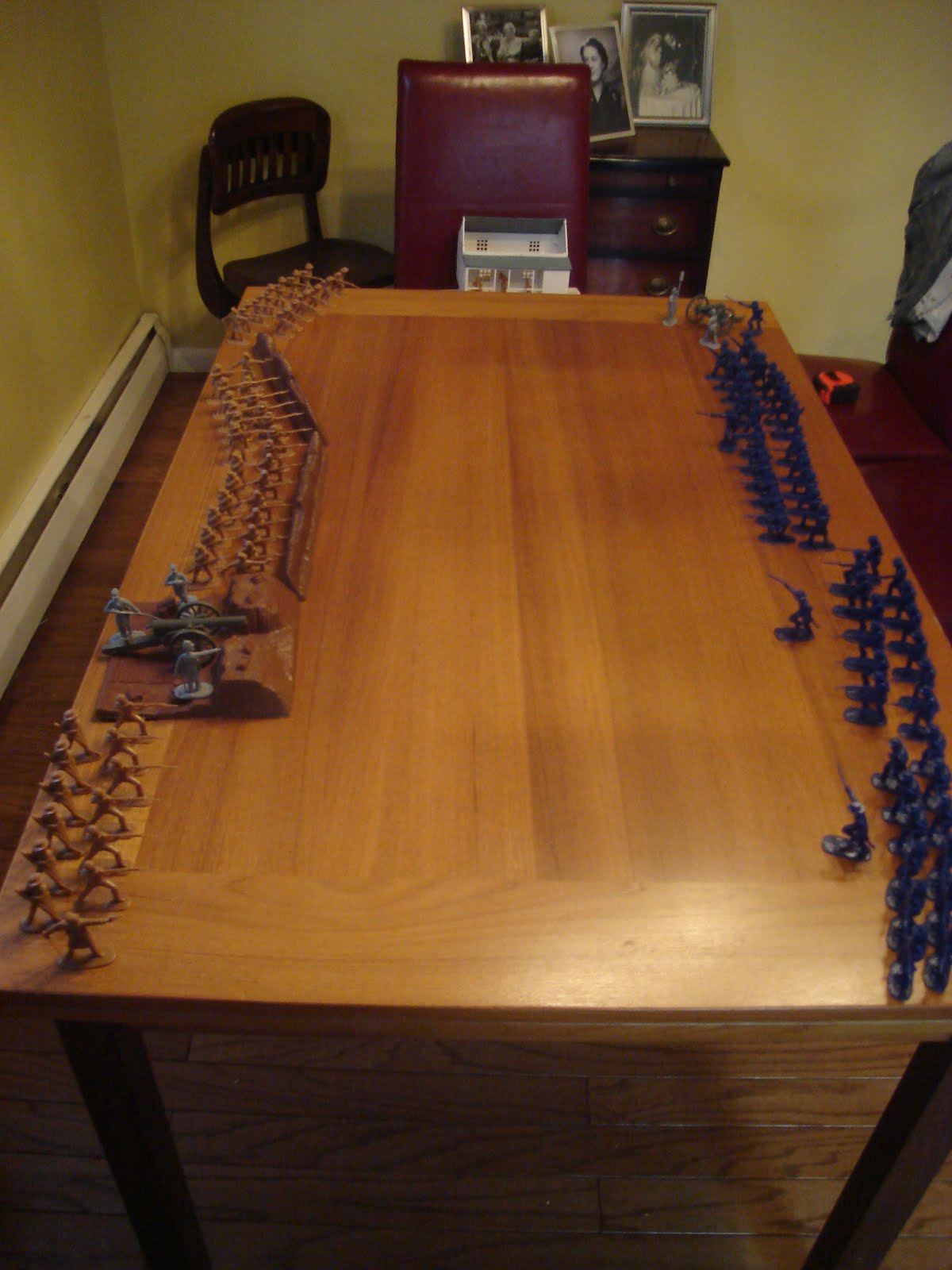
And both sides in opposition. At 6 feet, pretty discernable figures!  Eye-catching spectacle could look great at a convention game.
Forward! Looks like some just prefer shooting, however...

This is a nice force!  The big question is painting them up. They are sorta fun to play with as-is, and might make a good example of what you can do with minimal effort to have fun wargaming. Lots to think about going forward!