How Men of Quality Resolve Differences

How Men of Quality Resolve Differences
Pudel and Peper attacks - an ugly but inevitable part of any 17th C. British Civil War, "Oh! The Shame of it All!"

Tuesday, November 17, 2020

COA Analysis and Training Exercise in One-Hour Wargames

"Based on our Wargaming - and my cool facial hair - this is the best COA, Sir"

fom https://warontherocks.com/
OK, but what would Neil Thomas think...?

In the 1:1 scale Army, a COA [ko-uh] is a Course Of Action. During the decision making process, COAs are wargamed to see what the likely outcomes are and evaluate problems. Wargamers rarely get into COA analysis for several reasons, IMHO:

  1. They don't know how and can't be bothered - it's just a game,
  2. They don't have the time. They'd rather just game it out. Arguably, that results in an analysis of the COA but it usually inaccurate due to it being a "success assessment" rather than "a probable outcome assessment".
  3. They don't know the rules well enough to perform an analysis,
  4. Related Point: Most miniatures rules take too long to play out and are too hard to analyze - they have so many variables, it would take almost as long as to play it out, anyway,
  5. Related Point. Most games don't know how to calculate the odds in their games.
But in  One-Hour wargames, there's A LOT more time to think, since the game plays much faster. Also, since the mechanics are simpler, it is easier to average out the results. The only variable is the combat mechanisms, which use a 6-sided die. The average roll is a 3.5, so to minimize chance for the thinking process, on an odd turn the dice could all roll 3's and on an even turn the dice could all be 4's. Units inflict d6-2, d6, or d6+2 Hits, resulting in 1.5, 3.5 and 5.5 Hits on average, depending on their attack ability. This example assumes we are using the OHW rules mostly as-is.

How do we visualize this in a scenario?
Take Scenario #12: An Unfortunate Oversight. This requires some important decisions be made regarding the base of fire and the maneuver elements of the attacking side.

One of the key questions the Attacker has to decide is what forces oppose the town, if any, and what cross the ford to attack the hill. Fire units - Guns, Artillery, Mortars, etc - are obvious choices to leave on the original side of the river, safe from a Defender's counter-attack, and doing what they do best, providing fire support. But seizing the town would provide an excellent, protected base of fire against the hill!  What to do?  A COA analysis, of course!

It should be noted that ALL fractions in OHW are rounded up in favor of shooter / attacker. So even a 1.25 or less is rounded UP. I'm OK with this since it takes into account fatigue and such related to being under fire at all, much less actually taking casualties.

In the Horse and Musket rules, the Fire of the various units is as follows:
- Artillery, Skirmishers d6-2 [average of 1.5 Hits/Turn, rounded up to 2]
- Infantry, d6 [average of 3.5 Hits/Turn, rounded up to 4]
- Cavalry have no Fire ability. However, they Charge for d6+2 Hits.

So, two batteries of Guns and an Infantry Unit, inflict an average of 8 Hits per turn, enough to destroy one Unit in 2-3 turns with a bit of luck [all Units have 15 Hits]. However, against a Unit in a Town, all Hits are halved. This averages out to 4 Hits/Turn, or four Turns to destroy an occupying Unit. 

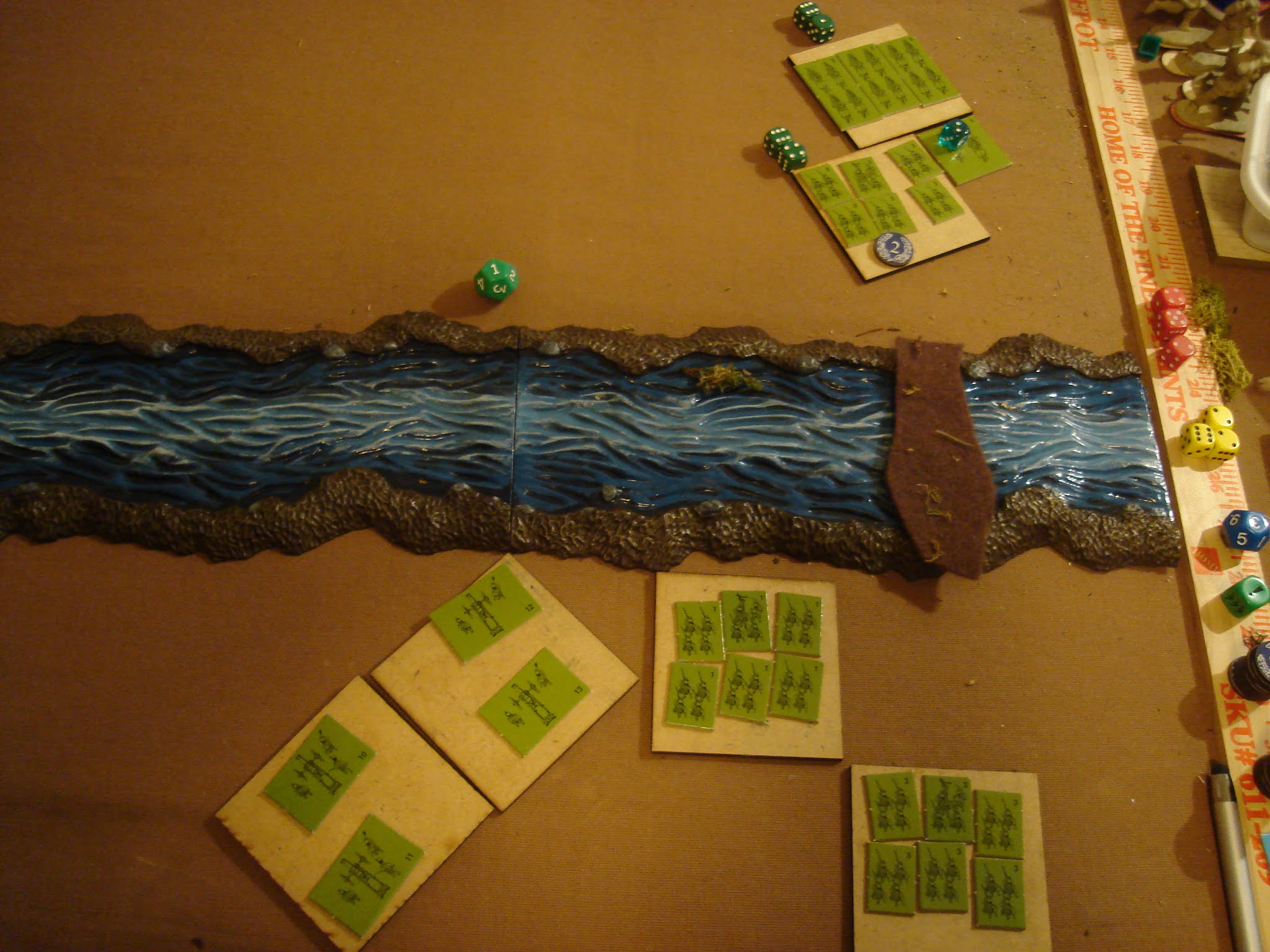
Below: The Russian Artillery inflicts 1.5 Hits [green '1', black '5'] a turn. This rounds up to either 4 Hits against a Unit in the open [red '4' above] or two against the town [red '2' on ruler]. The Russian Infantry Fire for 3.5 Hits [green '3', black '5'] a turn, rounding up to 4 Hits halved against the town. Net is 4 Hits against the unit in the town a turn. The unit in the town will be destroyed in 4 Turns on average.
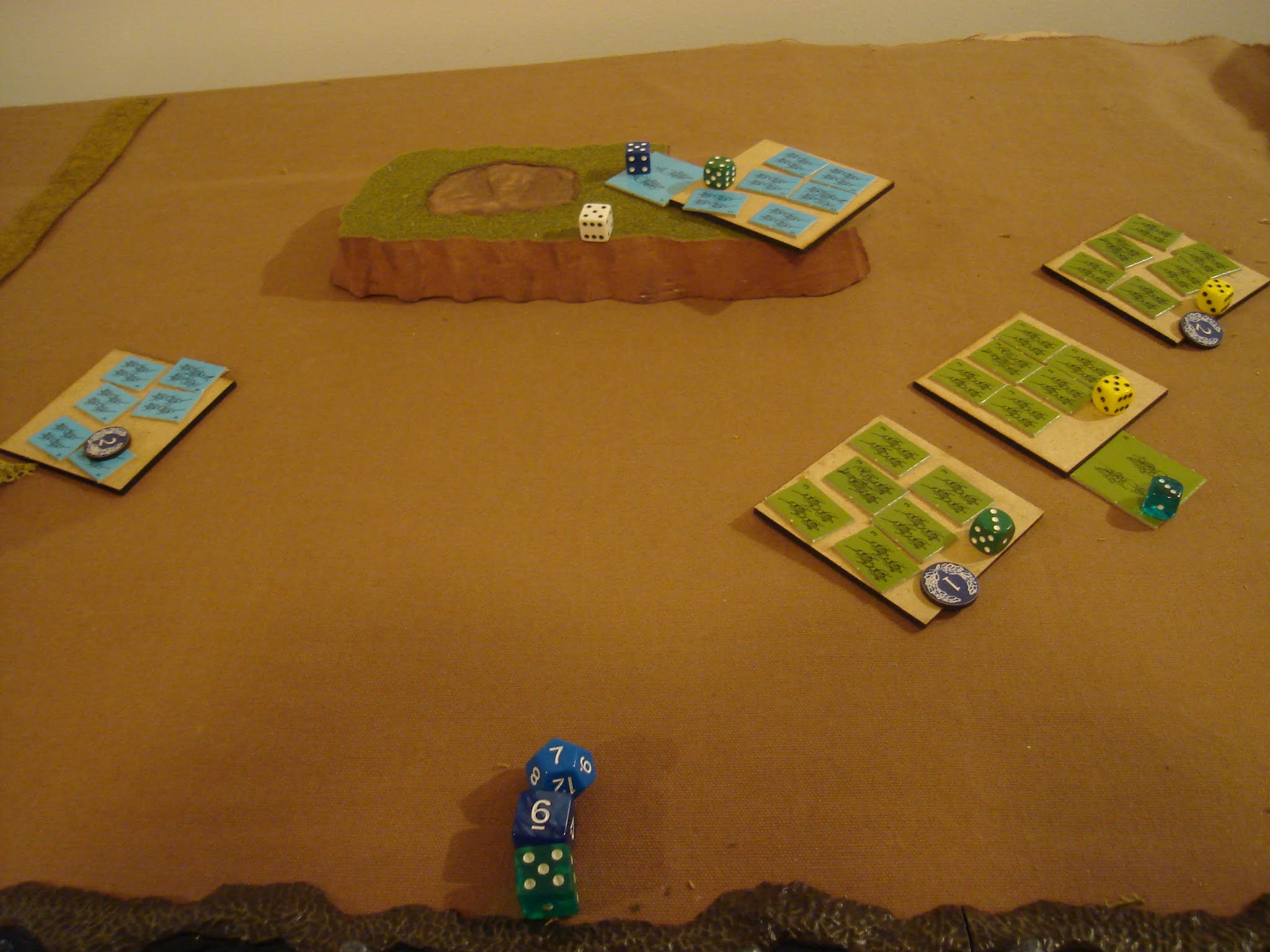
Above. Opposing them is a French Infantry Unit, which Fires at the Russian Infantry for full effect of 3.5 Hits/Turn [blue 3, black 5] rounded up to 4. This means it will inflict about 12 Hits on the Russians [who shoot first each turn] before being destroyed on Turn 4. However, with a bit of luck the French might destroy the Russian Infantry by rolling a little high, before being finished off by the Artillery.

Luck aside [I know, for some of you this is hopelessly optimistic!] This means that the Russians will move into the town on Turn 5, albeit with a battered infantry Unit with 11 Hits.

What will this look like as a training exercise on the wargame table?
Setting aside luck and rolling averages of 3 one turn, and 4 on another turn for all participants, we get our average of 3.5 for all dice - some of you may want to play all your games like this!

Turn 1. Cavalry spearhead the flanking maneuver across the ford, followed by two Infantry.  Guns and third Infantry inflict four Hits on French Infantry, while receiving 4 Hits on the Russian Infantry.

Turn 2. Russian Cavalry menace the hill's flank and rear. Infantry continue to advance. All Fire dice are a '3' and rounding give the Russians 4 Hits on the French while the French get 3 Hits. Note: the rounding up gives a slight advantage to having multiple units firing.

Turn 3. Russian Cavalry seize the hill [in this unopposed exercise] while the Infantry advance to support by Fire and seize the objective. The town fight has the French at 12/15 Hits, and the Russian Infantry at 11/15 Hits.

Turn 4. Russians are on the objective. If Opposed, they would be engaged a bit to the lower right by French occupying the hill. Still, we can see the timing involved. At the Town, the French Infantry are destroyed and do not Fire in their half of the Turn.

Turn 5. Russians advance into the town. Artillery may be turned onto the main effort against the hill.

Analysis
Seizing the town most likely takes too long, and requires too many resources - fully half the force needs all its firepower to advance into the town by Turn 5. Granted, with a little luck they may advance in on Turn 4, but that still has the Russian Infantry firing out from the far end against the French no sooner than Turn 6.

Meanwhile, the guns are not Firing in support of the main effort, having spent 1/3 of the game supporting what is only a Supporting Effort. At an average of 4 Hits/Turn, they could destroy one enemy Unit in the main battle by Turn 4 or so, or provide key supporting fire to their own Infantry and destroying a second with their supporting Fire.

The Victory Condition is the hill, not the town or the road. Note that if the victory condition WAS the town, or clearing the road, this would be the main effort. In this case the flanking effort at the ford would be only the Supporting Effort and perhaps have its forced reduced or its movement delayed.

Conclusions
In most gaming events, the players arrive at the hosts venue and see the table for the first time. The scenario is then explained and they've a few minutes to decide on a Course of Action. With a simpler game and scenario, it is much easier to distribute the scenario in advance, representing the staff and general evaluating the scenario as the force moves towards the battlefield. This in turn allows players to actually move the units in the battle space, or at least make some measurements to determine what the timing looks like. 

If players are familiar with the combat power of their units, i.e. the combat mechanics, they can still develop a plan based upon the known movement rates and likely combat results.

Finally
I think if more wargamers did this occasionally, they would be better wargamers, and they would also learn something about how real military staffs and commanders evaluate situations and develop Courses of Action leading to a Plan. With a quick-playing game like OHW, this is much easier to do. So collect your staff and get planning!

Sunday, November 15, 2020

EC-BC Playtest 2: The Eagles Wavre...

We will cross the ford, outflank the Наглец  Frogs and take the hill!


https://commons.wikimedia.org/wiki/File:Kutuzov_fili.jpg

The two sides face off again on One-Hour Wargame #12: An Unfortunate Oversight. This time the Russkies are on the attack. They've great Gun support with two massed batteries, but only three Infantry brigades and one Cavalry brigade.

The French have four Infantry brigades, one Cavalry brigade and a battalion of Lights.

Both sides have a general, the counter with two mounted fellows on it.


French set up first. One question for them is what to do with the lights. There's no rough terrain for them to work in, and the town can be Assaulted. If the Russians throw an Infantry battalion at it, they may not be able to hold it. In the end, I put Infantry in there since they are the most powerful unit and have the best balance of firepower and endurance in the game. As long as they are completely within the town, the Artillery can't see them unless they got very close. And the reverse is true.
French setup is below. The hill is the victory objective, and the Cavalry and lights will take the outside flank, with three Infantry brigades on the inside to hold the hill itself. All Units must be "within" 12" of the town, which I take to mean the entire Unit is within 12", not just an edge.

Russkies set up with their batteries close enough to Bombard the French force, and the rest prepared to cross as quickly as possible, lead by the Cavalry.
Russians have Initiative automatically on Turn 1 since they are the Attacker. As is often the case, they manage to blow the Order roll for the crossing - clearly, crossing the Ford is more difficult than I think! They roll a natural '1' which goes up to '2' since I always give the Attacking side a +1 on Order, to make up for the burden they have of movement. Now the question is - what to do with the Orders...
I could give the Guns Bombardment orders to soften up the French...
...but I feel time is of the essence and order one Infantry to follow the Cavalry which is being lead by the General personally, so counts as having the 2 Orders needed to March. Both roll quite well for the March, and it looks like the Russkies are off to a quick start!
The French outperform on Orders, and prepare their outer flank and first Infantry to March.
End of Turn 1, the french are on the hill, and have the outer flank covered.


Turn 2, Order rolls are both a '3', and Russkies retain IN. They push on while urging their other Units to move along and the Guns to Bombard - which causes 2 Hits on the French Infantry on the hill but one goes Low on Ammunition. In retrospect, I should have Marched the other two infantry while holding with the advance force...

French Action Phase, they charge in with the Cavalry, getting three Hits to two [I changed the Hit number for Cav v. Cav to 5+ from 3+, as they historically tended to engage quickly but not cause a lot of damage to each other]. As they got three Hits, the Russian Cavalry take a Permanent Hit as well.

End of Turn 2, the French look like they will easily hold the hill and possibly trash the Russian advance guard. Have I once again bolloxed things up for the Russians?? Where is Kutuzov when you need him??

To make things worse, the French seize IN turn 3. I think the French will win again...

At least the Russkies rolled for plenty of orders, they will need them. The French blow it with one Order. They decide on a very limited objective for the turn - finish off the Russian Cavalry. The Russians opt to March reinforcements, while pushing their Infantry forward to support the Cavalry and one Bombardment, also.

Despite the Order which give them a bonus die in the melee, the Russians are crushed by the French Cavalry who obey Napoleon's First Law of Wargaming - Roll Lucky! They get the two Hits needed to destroy the Russian Cavalry, who get no hits in return.

The Action Phases see the French repositioning themselves well, outnumbering the Russkies where it counts. The Russkies manage to roll a crazy march of 14" and have two Infantry in position. The third is getting along while the Bombardment results in another Hit on the French Infantry on the hill.

In the Fire Phase, the French blast the left Infantry for 4 Hits to '5', one Permanent. In response, they take only one Hit back. It's not looking good for Mother Russia, altho the French are a bit strung out they have four Units fighting on the objective, and the Russians are down to two.

OK, with a few detailed turns in there to give a feel for the game mechanics, we'll move a bit quicker now.

Turn 4, the French retain the IN while the Russians bring up their third Infantry brigade. The firing lines are set, altho the French are a bit weaker they've the Cavalry supporting. They really need their other two Infantry brigades in the Action, but are clearly more than holding their own as they may break the center Russian Infantry at any moment.

Turn 5, the French Lights break, while the center Russian Infantry is just barely holding on.

Turn 6, the French Cavalry have a go at the Russian Infantry, who miss completely with their defensive volley. However, they roll great in the assault, and almost destroy the French Cavalry who still manage to put the hurt on them in return. Still, with a tie the Cavalry retreat.

Turn 6 Action Phases end with the French rallying one Hit while the Russians roll amazingly well and rally two Hits off both their center and left Infantry. But the Russian Guns both hit and the French right Infantry is one Hit from oblivion...

In the Fire Phase, the Russians blast the French right to pieces, and getting the last Hit needed to destroy the cavalry, while the French plink away in return but unable to seal the deal and bag any Russian Infantry - frustrating!

Turn 7 starts with a lone French Infantry holding the hill. The French have three fire dice in the main battle line, while the Russians have seven - the French must bring up their reinforcements!

Turn 7 sees the French in motion. The Russians again manage to rally off two Hits from their center Unit, and take two Hits again in the exchange of Fire. The fresh French Infantry gets a bloody nose from the same sniper-like accuracy of the left Russian Infantry. The French are outnumbered in the battle, but have the Force where it counts, while the Russians are not always going to be able to use their Guns to support their firing line. Both lines overlap the other's left, but who will exploit it successfully is the question.

Turn 8, the French blow all their rally rolls. They successfully move up their right Infantry to a flanking position on the Russian left, where their Infantry are two Hits from destruction.

During the Russian Turn 8 Action Phase, they manage to - again - rally off two Hits in the center, altho none anywhere else. The French have 8 Hits on their three Infantry, the Russians 12 and the French will shoot first. This seems like the end of a hard-fought attempt to force the crossing for the Russians...

The Russian Guns even miss AND go low on ammo. Dasvidaniya comrade?

But, wait... First, the French let completely miss! Just rolling average would've destroyed their opposing Russian Infantry! The second Russian battery gets a hit but goes low on ammo.

The Fire Phase ends with the French getting the worst of it, losing the center Infantry and the attached General, while again not eliminating any Russian Units.

"Sacre Bleu - le centre est frappe!!" Or something to that effect. "Merde!"

Turn 9, the French lose the IN to the Russians. To make matters worse, the wily Russky general rolls enough Orders to do anything he may want to do...

The Russians again rally well, losing two Hits on the left Infantry and one on the center infantry! Their guns then beat the heck out of the near French Infantry [altho I think I made a mistake with all the pic taking - one was low on ammo, most likely].

Still, the French rally two off their left Infantry, altho none on the Right.

In the Fire Phase, the French lose their Right Infantry.

Well, this isn't what I was expecting a few turns ago! The French should pull back and find another Corps nearby to beat up this isolated Russian bridgehead, shouldn't they? They concede...

Well, with all the pic taking and note taking, I may have made an error or two, but the Russians played very conservatively in the mid-game, and brought up their Infantry support quicker than the French, who didn't seem to need it right away and were solidly in a fight on the objective they didn't want to lose. Amazing Russian Rally rolls helped them hold on in the center, while French Fire was a bit weak and just enough to cost them the fight, especially when the Russian Artillery made their influence felt.

Overall, I think the rules are playing very well. I have made a couple of tweaks regarding cavalry and lights, and will probably have to take a deep breath and revisit these again later, and see if a few things can be simplified out. But Napoleonic forces tend to be a bit more complex, with most sides having balanced forces and lots of command choices. I feel like I played both sides pretty well, and that in the end the Russians out rolled the French at a few critical moments, which turned the tide in their favor. A real nail-biter, to be sure!

Friday, October 23, 2020

EC-BC v. 4 Playtest: Eagles Cheaper than Brain Cells LIVES!

  The French storm the hill in One-Hour Wargames Scenario #12!

Well, maybe it is Borodino... http://napoleon-complex-gaming.blogspot.com/2015/12/black-powder-battle-of-borodino.html

One-Hour Wargames, Scenario 12: An Unfortunate Oversight
This first run-thru should be called "An Incompetent Oversight" considering how badly I played for both sides. My only excuse is that it does take a few practice runs to determine how mechanics translate to the table and it is distracting to tactical thinking to be trying to remember the game mechanics!  This is yet another reason why "simple is better" for us poor Armchair Generals. Still, #12 is a fun scenario, with Blue dodging a strongly held bridge at a town and executing a flanking maneuver via a ford unknown to Red. 

For the force roll-up, the '2' for the Russians resulted in 3 INF, 2 GUNS, 1 CAV.
The '6' for the Frenchies results in 4 IN, 1 Skirmisher, 1 CAV. This is a pretty interesting force combo, with my interpretations below.

The French, seeing the town of Redinsky being strongly held by a covering force, set their scouts to work and discover a ford a couple kliks away. It is covered at long range by the Russian batteries, but there is no infantry or cavalry nearby. Marshal MacDonald decides he has to go for it, lest his Corps fall behind the schedule set by Le Petit Emporeur! The hill is the key - to secure both crossings, he must seize it!

Below, the wretched setup. 
I've interspersed the Russky guns with the infantry and cavalry, and it is too late to reposition them. The French are going for broke at the ford, with the Light infantry battalion screening the bridge and exchanging potshots with the infantry brigade holding the town. The French roll a '5' for Orders and the Russians a '1'. At least the French will be able to get moving as it costs 2 Orders to March, but Marshal Mac automatically gives full orders to any Unit he is with. The Russians order the closest Infantry and the Cavalry, trying to block the ford as quickly as possible.

The French, having Initiative [IN] have to take Actions first. They blow the crossing, rolling a '3' with 2d6 and getting only 9" with the Marching Cavalry. They are now in the way [they could've rolled a '12' for 18" total...].  The following Infantry brigade does the best it can to move around them, but the next Infantry also rolls a '3'!
As the outflanking maneuver plods along against quickly-moving opposition, the Lights inflict a hit with their patrols that have snuck across the bridge. As the Russian batteries were not ordered, they cannot Bombard out to the 24" range needed to cover the crossing. I felt it was more important to maneuver forces to oppose the French crossing, which has bogged down - will this forward defense result in victory for the Czarists?  It certainly looks possible...

Turn 2, Orders are a '4' each. French place theirs since they've the IN. The French prioritize pushing ahead in the teeth of the Russians, while the Russians work to maneuver more forces against the crossing and Order one Bombardment from the battery on the hill. The French then retain the IN for the turn.

With the IN, the French are able to push ahead, moving their CAV out of the way and getting two more Infantry brigades across. The Russians are able to lay down some effective Fire, inflicting 4 Hits total.

At this point, it should be noted that I am forgetting little bits and pieces of the rules, and doing a few things out of order. Haven't played in a while, and I'm correcting best I can, but...

Turn 5, French are pushing to expand their bridgehead, but lost the Cavalry [with the General] to a Russian Cav charge. They in turn were forced to retire with a few Hits in the face of advancing French infantry. One French brigade has 6 Hits, pushing it against the wall of destruction at '7'. However, the Russians lost their center Infantry brigade due to concentrated French Fire. The French Lights are threatening the Russian Guns. 
The Russian Infantry has advanced against the ford, but they are not protecting the hill, which is after all the objective. Continuing the next day, I replaced the green casualty dice with white. French IN dice is blue while the Russians is green.

Turn 7, the Russians have seized the IN and maneuvered their Cav for a charge against the Lights to protect their guns from Fire [the Lights can't charge]. The French saw this coming and gave the Lights an Order - this allows them to Fire at the oncoming Cavalry. Needing 5+ to Hit, they get two and nearly wipe out the Cavalry which only has 5 Hits!
In the ensuring melee, the Russians get only 1 Hit needing 3+ and the Lights get two needing 5s!  The Russian Cav wander back to town to reform, taking the general with them. The Guns are now going to be subject to plinking fire...

Turn 7 is shaping up to be a pivotal turn. The French Unit managed to rally a few hits off thanks to the General's presence. The Russians get three Hits against the fresh, center French Unit, inflicting permanent losses [yellow '4'].
But the French inflict three Hits against the weakened lower Russian Infantry Brigade with 4 Hits. At '7' hits, it is Bye-Bye Russkies!
Turn 7 finale. The French have two Infantry that are shaky, but the Russkies only have one Infantry left, altho it is in great shape. Time to withdraw to the hill?

Turn 8, the Russians withdraw to the hill, but the French are able to chase them successfully and then get three hits on the retreating brigade! The French also successfully rally off three Hits on the other Infantry Units.

Russians concede. With the one badly shot up infantry, their general in a time-out, and two more French infantry rallying themselves while their Lights harass the Guns, I don't see a way for the two Russian batteries to defend the hill. I regret ordering the Russian infantry to withdraw, but it was still probably the best thing to attempt given the circumstances.

In Eagles, Infantry are the queen of the battlefield - they represent a full brigade with support, and have the ability to both Assault and take ground as well as bring effective Fire to bear, even while maneuvering.

Well, that was a sloppy play-thru, with lots of tactical and mechanical errors along the way. I certainly need to re-play this with my head screwed on better for both sides!

Eagles is showing itself to be a strong but simple play in this draft. While the turn sequence is pretty straightforward it takes a few turns to get used to the subtleties, like Artillery Bombardments happening during the Action Phase and not the following Fire Phase. It definitely works well with OHW scenarios and the OHW varied force structure doesn't seem to be a real problem. I think the Russians could fight as Blue with the French as Red and it will be an interesting scenario with Russian gun superiority to cover the crossing and French Infantry superiority to hold the hill. Hmmm, I'll have to try that!